

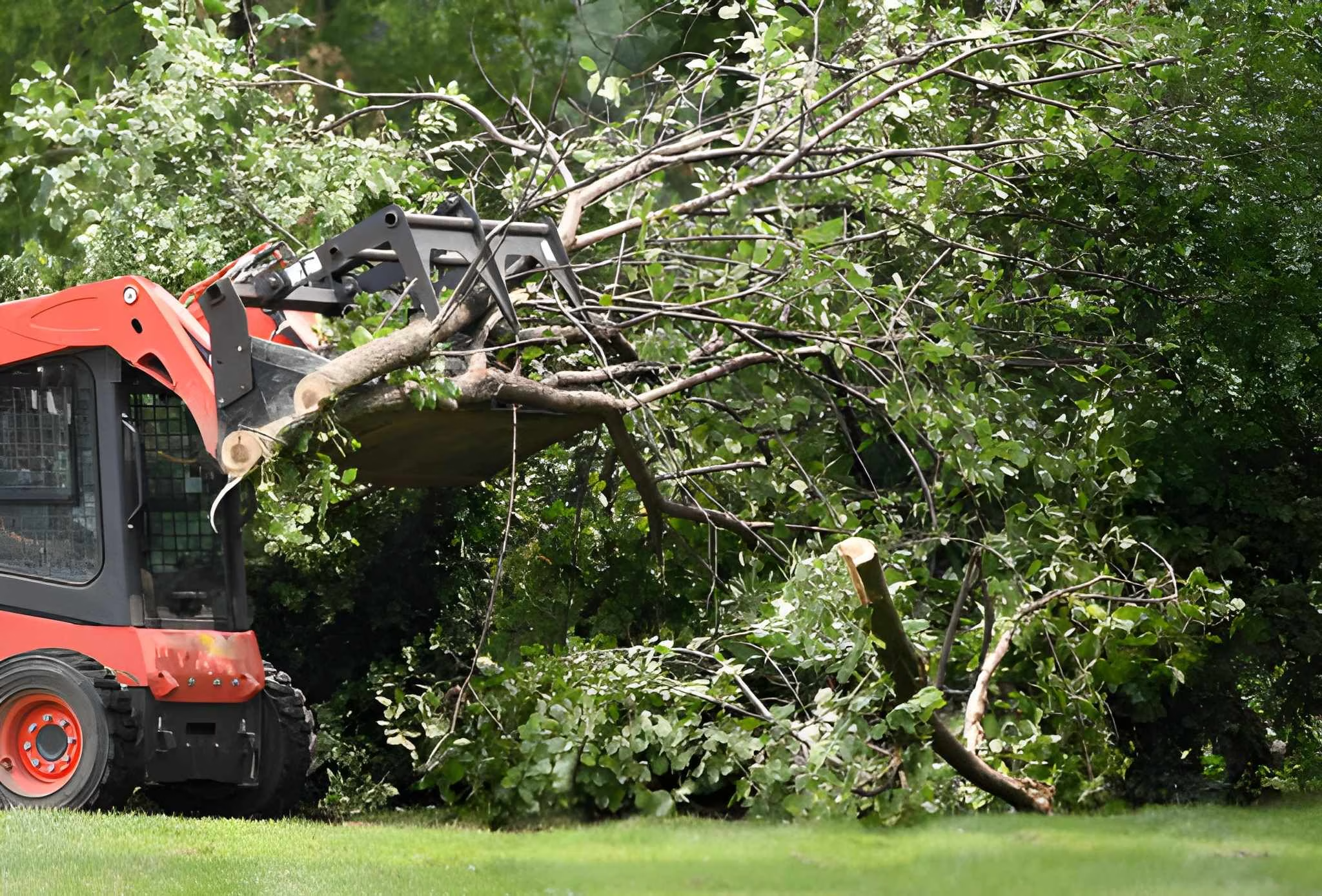
A tree does not have to fall to suffer storm damage. Broken branches can remain caught in the canopy, splits may be difficult to see through foliage, and changes around the base can indicate movement that deserves assessment.
After a storm, look for changes from a safe position rather than walking beneath the tree to inspect it. Hanging branches, fresh splits or a new lean call for prompt attention. Clearing fallen debris does not establish that the remaining tree is safe.

Deal with immediate hazards first
Keep people and pets away from a tree with visibly broken or hanging branches. Avoid using the patio, driveway or entrance beneath the affected area until the concern has been assessed.
Do not approach simply because the wind has stopped. A damaged branch may remain suspended after the weather improves.
If a powerline is down, stay at least 10 metres away, keep others back and call 911 and the local utility. Assume the line is live. Do not touch the tree, branches or objects in contact with it.
For an urgent tree concern without an electrical hazard, call Toronto Tree Service at 647-624-6920 and describe what you can see from a safe location. Tell us if a branch is above an occupied area or the tree appears to have moved.
Look for changes, not just debris
A pile of fallen twigs tells you something came down. It does not explain the condition of what remains overhead.
From a safe viewing position, note whether the crown—the branching, leaf-bearing part of the tree—looks different. A branch may sit lower than before, point in a new direction or appear disconnected from its usual position.
Useful observations include:
- A broken branch lodged among other branches.
- A limb hanging lower than before.
- A fresh split in a visible trunk or branch junction.
- A new change in the tree’s lean.
- Newly disturbed or raised soil around the base.
These are reasons to seek assessment, not instructions to investigate closely. Do not pull on a branch, shake the tree or clear material around its base to get a better view.
A hanging branch may still have green leaves
Leaves do not need to turn brown before a broken branch becomes a concern. Its position and attachment matter more than its immediate colour.
Likewise, an intact-looking canopy does not confirm that every branch junction or concealed section is sound.
If you cannot see the attachment point clearly, report that limitation. Avoid trying to resolve the uncertainty by standing directly underneath it.
Use earlier photographs to identify movement
A familiar tree can look subtly different after a storm. Earlier photographs may help establish whether a low branch or lean is new.
Look for images taken from similar positions. Compare the tree against fixed reference points such as a building corner, fence or roofline.
A photograph from a different angle can create the appearance of a change, so be clear about what you know.
For example:
“The branch appears lower than in our photograph from June, but the images were taken from different positions.”
Or:
“The trunk now sits closer to the fence, and we can see newly raised soil on the opposite side.”
The second observation gives a more specific reason for concern. Neither requires you to diagnose the damage.
If a change appears urgent, contact us immediately. Finding a better comparison photograph should not delay the call.
Consider where a damaged part could fall
The same visible defect can have different consequences depending on its surroundings.
Tell us whether the affected section is above a home entrance, public-facing business doorway, parking area or space regularly used by children. Explain whether that area can be kept closed.
Where practical, stop using the affected space from a safe location. Do not walk beneath a suspect branch to move furniture or retrieve a vehicle.
A useful description is:
“A broken limb is hanging above the rear patio. We have stopped using the patio, and the house entrance is on the other side.”
That communicates the defect, its surroundings and the precautions already taken.
For businesses and managed properties, let the appropriate site contact know so occupants do not continue using an affected route.
Separate cleanup from assessment of the remaining tree
Removing a fallen branch and assessing the tree it came from are related tasks, but they are not interchangeable.
A cleanup proposal may cover material already on the ground. It may not include examination of the remaining crown, trunk or base.
When arranging emergency tree services, identify both concerns: what needs immediate attention and what remains uncertain about the standing tree.
For example, a large limb on the driveway might be removed while questions remain about the junction where it broke. Clarify whether the proposed work includes assessment of that area.
Before reopening the space, establish what has been addressed and whether any restrictions or further assessment remain necessary.

What can an assessment establish?
An assessment considers the observed damage alongside the condition of the remaining tree and the surrounding site.
It should help explain whether damaged sections can be addressed while retaining the tree, whether further investigation is needed or whether the damage makes retention unsuitable.
The scope matters. A ground-level visual examination has different limits from a closer inspection of an obscured branch junction.
Ask what was accessible, what could not be confirmed and whether those limitations affect the recommendation.
An assessment should also distinguish existing defects from changes reasonably associated with the storm. The timing of discovery alone does not prove that every observed problem is new.
Storm damage does not automatically mean removal
Some trees can be retained after damaged branches are addressed. Others suffer damage that makes continued retention unreasonable.
The decision should follow the findings rather than the size of the debris pile or the tree’s altered appearance.
If work is recommended, ask what it will achieve. Does it remove a broken section, address a particular structural concern or form part of a longer management plan?
Avoid assuming that extensive cutting will make the tree “storm-proof.” No pruning or support system guarantees that a tree will withstand future weather.
Where the assessment supports retention, understand any follow-up requirements. Where it supports removal, the explanation should identify why a smaller intervention is insufficient.
Check ownership and permissions
In Toronto, report hazards involving City-owned trees through 311. Do not assume a tree belongs to you solely because it stands close to your driveway or front lawn.
For privately owned trees, the property owner is responsible for arranging assessment. If a concern involves a neighbouring tree, stay clear and advise the owner rather than entering their property to investigate.
Storm damage also does not create a general exemption from tree-protection requirements. A damaged protected tree may still require permission before removal.
Toronto provides an exception for an imminently hazardous tree, with photographs and notification to 311 requested to document the circumstances. That exception should not be treated as permission to remove any tree that looks worse after a storm.
Where there is no immediate hazard, confirm the applicable requirements before authorising work. Properties outside Toronto need to follow their own municipality’s process.
Send a clear description when requesting help
A short, specific message helps us understand the concern more effectively than “the tree was damaged.”
Include:
- The property address and tree’s location.
- What appears broken, displaced or changed.
- Whether the affected area is occupied or can be kept closed.
- Any involvement with electrical lines or buildings.
- Photographs taken safely.
- Whether work has already occurred since the storm.
For example:
“After last night’s storm, a large branch is hanging within the crown above our driveway. We are keeping the driveway closed. No electrical lines appear involved. We have attached photographs from the front window.”
Describe only what you can establish. If ownership or the attachment point is uncertain, say so.
Keep a record after the initial work
Retain photographs, assessment findings and the agreed work scope. If property damage occurred, contact your insurer about its documentation requirements when safe to do so.
The completed work should leave you with a clear understanding of what was resolved, what remains and whether further review is recommended.
If monitoring is advised, clarify what change should trigger earlier contact. A new split, newly displaced branch or further movement should not be treated as routine simply because an earlier visit occurred.
Avoid relying on a general statement that the tree “looks fine now.” The useful information is what was examined and what the findings support.
Frequently asked questions
Can a tree have storm damage even if no large branches fell?
Yes. Broken branches can remain caught in the crown, and splits or movement may occur while the tree remains standing. Look for changes from a safe position. The absence of fallen branches does not establish that the tree is undamaged.
Does removing fallen debris make the remaining tree safe?
Not by itself. Debris removal may address material on the ground without assessing the remaining crown, trunk or base. Confirm whether the work includes evaluation of the standing tree and whether further assessment or access restrictions are needed.
Does a storm-damaged tree need to be removed immediately?
Not every damaged tree requires removal. The response depends on the extent of damage, the remaining structure and the surroundings. An immediate hazard needs urgent attention; other cases allow assessment and confirmation of applicable permissions before work proceeds.
Arrange assessment of suspected storm damage
If your tree has changed after a storm, tell us what you have noticed and which areas are affected. For an urgent concern, call 647-624-6920 rather than waiting for a quote-form response.
For planned assessment or follow-up work, request a quote with photographs and a brief description. We’ll explain the appropriate next step and the proposed scope.

Colin is the founder and owner of Toronto Tree Service – TTS, bringing years of experience in tree removal, pruning, and safe property management. As a member of the International Society of Arboriculture (ISA), TTS follows recognized arboriculture standards and best practices. Colin remains actively involved in projects to ensure consistent, high-quality results throughout Toronto.


